Name: ______________________ Date: __________ Station: ______
Lesson 6.17. Page 1 is the place setting for 30 covers. Page 2 is the serving order and the host line. Page 3 is the four clean-up zones and the station check. Page 4 is the cost comparison and the four-question project reflection. Page 5 is the teacher key.
Page 1. The Place Setting (30 covers)
This is the same setting you learned in Lesson 6.11. A cover is one person's place at the table. One student per table area checks every cover against this diagram and fixes what is wrong.
The diagram, in words (draw it on the board too)
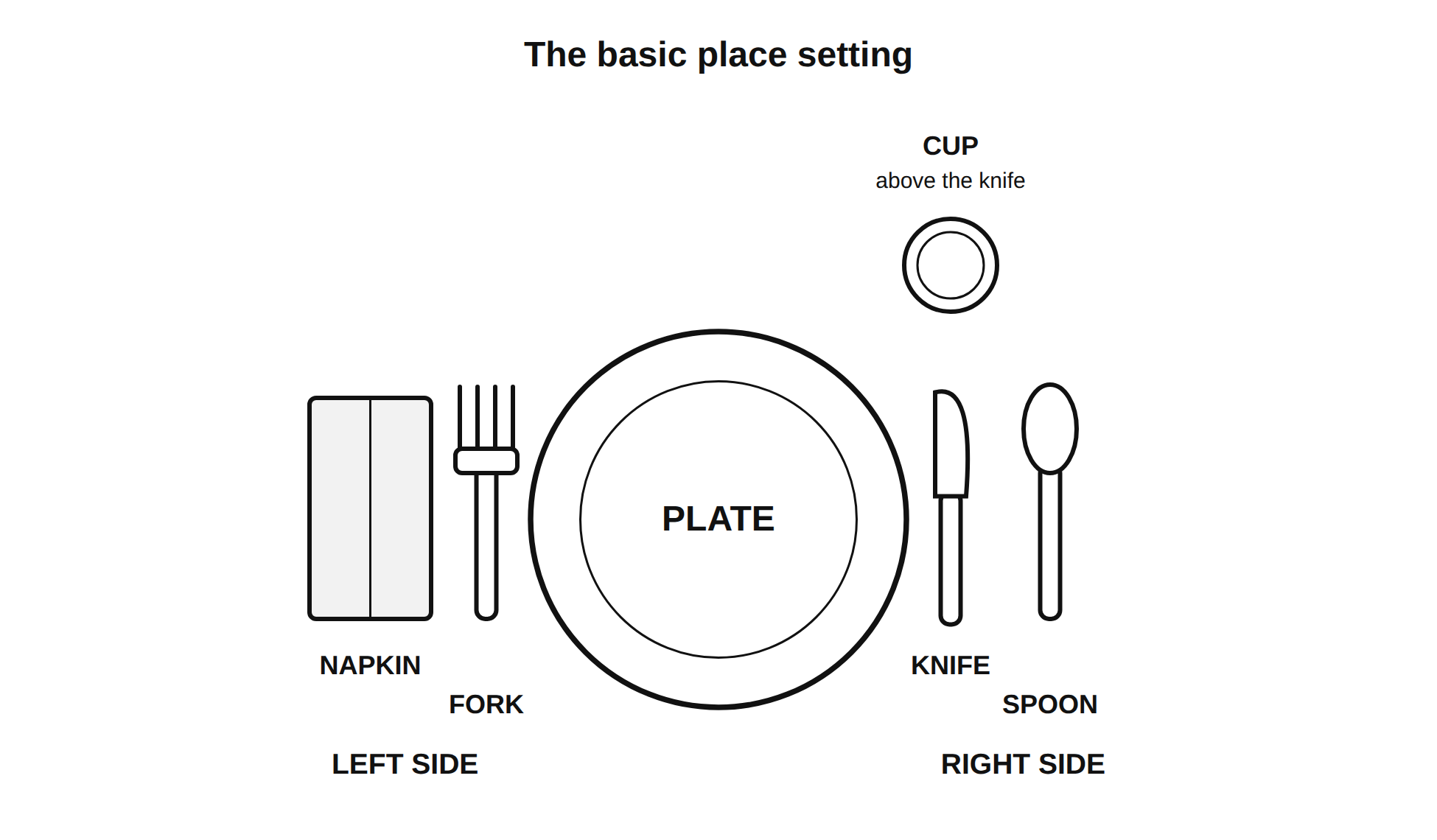
| Piece | Where it goes | Why it goes there |
|---|---|---|
| Plate | Center of the cover, about one inch from the table edge | It is the middle of everything |
| Fork | Left of the plate | Most people hold the fork in the left hand while the right hand cuts |
| Napkin | Under the fork, or folded on the plate | Where the left hand reaches for it |
| Spoon | Right of the plate, outside the knife | Right hand, and it is used last |
| Knife | Right of the plate, blade facing in toward the plate | Blade in, so nobody reaches into an edge. Our room: butter knives only, and only if the menu needs one |
| Cup | Above the plate and to the right, near the tip of the knife or the spoon | Right hand reaches up and over without crossing the plate |
The one-inch rule: everything sits about one inch from the edge of the table, in a straight line. It looks set on purpose, not dropped.
The cover check (one student per table)
| Cover # | Plate centered | Fork left | Napkin placed | Spoon right | Cup upper right | One inch from edge |
|---|---|---|---|---|---|---|
| 1 to 5 | ||||||
| 6 to 10 | ||||||
| 11 to 15 | ||||||
| 16 to 20 | ||||||
| 21 to 25 | ||||||
| 26 to 30 |
Checked by: ______________________ Covers fixed: ______
Two questions the teacher will ask you at your table
- Which side does the fork go on, and why that side? ________________________________
- Where does the cup go, and why there? ________________________________
- * *
Page 2. Serving Order and the Host Line
The order, and it is not negotiable
- Guests first. Anyone in the room who is not on your station.
- Teammates second. The others on your own station.
- Yourselves last.
Before the first plate goes out: the Station Manager reads the allergen box for the dish aloud to the whole class. If it was not read, the teacher stops the service.
During the meal: pass the serving dishes. Do not reach across a cover. A serving spoon stays with its own dish and does not travel.
The host line
At each table, one person is the host. The host says one sentence to start the meal, the way we practiced in Lesson 6.11. It can be in any language you speak. If it is not in English, say it in your language first. Then say it in English if you are willing. The table repeats it.
Our table's host is: ______________________
The sentence the host will say: ________________________________________
Sentence starters:
| English | Spanish |
|---|---|
| Welcome to our table. We made ___. Please start. | Bienvenidos a nuestra mesa. Hicimos ___. Por favor, empiecen. |
| Thank you for eating with us. | Gracias por comer con nosotros. |
| Everyone has a plate. We can begin. | Todos tienen un plato. Podemos empezar. |
| This dish is called ___ and it comes from ___. | Este plato se llama ___ y viene de ___. |
The table question
The teacher will come to your table and ask one question. Write your answer here.
"What is one thing about this meal that you would tell somebody at home?"
Answer: ________________________________________________________________________
Page 3. The Four Clean-Up Zones and the Station Check
Each station takes one zone. Switch zones each time, so no station always gets the floor.
ZONE 1: Tables and covers (Station ______)
- [ ] Every plate, fork, spoon, cup, and napkin cleared
- [ ] Tables wiped with sanitizer
- [ ] Chairs pushed in
- [ ] Nothing left on any table
ZONE 2: Sink and dishes (Station ______)
- [ ] Pots, pans, bowls, trays washed or rinsed and stacked
- [ ] Serving utensils washed
- [ ] Sink wiped, no standing water, no food in the drain
- [ ] Dish towels hung, not left on a burner
ZONE 3: Surfaces, stove, and oven area (Station ______)
- [ ] Counters sanitized
- [ ] Stovetop wiped
- [ ] Every burner OFF, confirmed by the Station Manager AND by the teacher
- [ ] Oven off, oven area wiped, nothing left inside
- [ ] Microwave wiped
ZONE 4: Floor, trash, recycling, tools, and the WASTE COUNT (Station ______)
- [ ] Floor swept, nothing on it, nothing wet
- [ ] Trash bagged, recycling separated
- [ ] Every tool returned to its labeled place
- [ ] Leftover food labeled and dated in the refrigerator, or in the trash by the two-hour rule
- [ ] THE WASTE COUNT filled in below and posted next to the Lesson 6.3 number
The waste count
How much food did we throw away today? Circle the method you used: weighed it / filled a container and measured / counted the plates with food left on them
Our number: ______________________
The Lesson 6.3 food waste audit number, still posted on the wall: ______________________
Circle one: we wasted LESS today / we wasted MORE today / about the SAME
One reason why: ________________________________________________________
The one question before the signature
Does this room look the way it looked before the bell? Circle: YES / NOT YET
Teacher signature: ______________________ Time: ______
Page 4. The Cost Comparison and the Four-Question Project Reflection
The cost comparison (from the receipt the teacher projected)
| Amount | |
|---|---|
| What we planned to spend on the whole class meal (Lesson 6.15 class total) | $__________ |
| What we planned per person (÷ 28) | $__________ |
| What the receipt actually said | $__________ |
| What we actually spent per person (÷ 28) | $__________ |
| The difference per person (actual − planned) | $__________ |
| Circle one: we spent MORE than planned / LESS than planned / exactly what we planned |
One reason for the difference: ________________________________________
(Real reasons: sales tax on the non-food items; an item was not on sale anymore; the store was out of the store brand and we bought the name brand; we bought one extra package as a spare; a size was different from the circular.)
Grade 8 stretch: the difference as a percent of the plan. (difference ÷ planned total) × 100 = ______ percent. The two receipt lines that explain most of the difference: ______________________ and ______________________
The four-question project reflection
You get 90 seconds of silent writing per question. Use your own papers as the evidence: your flowchart with the actual times, your costing sheet, your station card, the receipt.
1. What did our plan say?
Quote your own flowchart and station card. (a) What minute were you supposed to start cooking? (b) What minute were you supposed to serve? (c) What were you supposed to make?
Answer: ________________________________________________________________________
Line 2: ________________________________________________________________________
2. What actually happened?
Use a real time from the actual-times column. (a) Where did the plan hold? (b) Where did it slip?
Answer: ________________________________________________________________________
Line 2: ________________________________________________________________________
3. What did it cost, per person?
Planned: $______ Actual: $______ Difference: $______ Reason: ______________________
Line 2: ________________________________________________________________________
4. What would you change, and where exactly?
Name one change. Then point to one of these three: a block on the flowchart, a line on the shopping list, or a step on the station card. "We would work faster" does not count.
The change: ________________________________________________________
Where it goes: block ______ to ______ / shopping list line # ______ / station card step # ______
If we made that change, the thing that would get harder somewhere else is: ______________________
Line 2: ________________________________________________________________________
Sentence starters for the reflection
| English | Spanish |
|---|---|
| Our plan said ___. What happened was ___. | Nuestro plan decía ___. Lo que pasó fue ___. |
| We were supposed to serve at minute ___. We actually served at minute ___. | Debíamos servir en el minuto ___. En realidad servimos en el minuto ___. |
| It cost $___ per person. We planned $___. | Costó $___ por persona. Planeamos $___. |
| Next time I would change ___ in block ___. | La próxima vez cambiaría ___ en el bloque ___. |
| The reason is ___. | La razón es ___. |
Before you hand in the folder, check that it has all of this
- [ ] The constraint card and the choice sheet with the justification (Lesson 6.12)
- [ ] The role sheet (Lesson 6.12)
- [ ] The scaling table, the conversion strip, and the yield check (Lesson 6.13 Day 1)
- [ ] The costing sheet with the running total, the swap log, and the teacher signature (Lesson 6.13 Day 2)
- [ ] Your initialed rows on the approved consolidated shopping list (Lesson 6.15)
- [ ] The station card with the allergen box and the teacher approval (Lesson 6.14)
- [ ] The flowchart with the planned times AND the actual times (Lessons 6.14 and 6.16)
- [ ] The pre-flight check and your duty strip (Lesson 6.16)
- [ ] Both station check sheets, signed (Lessons 6.16 and 6.17)
- [ ] The cover check and the waste count (Lesson 6.17)
- [ ] This reflection, all four questions (Lesson 6.17)
- [ ] The Rubric 06 self-assessment row, filled in before the teacher scores
- * *
The teacher key for this handout is behind the teacher sign in. Teacher key